 Pcswap
 liquidity pools: Choosing a PancakeSwap Position
last updatedPancakeSwap pools supply tokens for AMM swaps, and liquidity providers share in the trading fees generated when swaps use their liquidity. Choosing a position involves the assets you will hold, the pool model and the range management it requires. V3 positions qualify for trading fees only while the pool price is inside their chosen range.
Section links
- V2 Position Record
- LP tokens representing a proportional share of the pool.
- EVM V3 Position Record
- A transferable NFT representing ownership of the position’s underlying assets and earned trading fees.
- EVM V3 Deposit Mix
- Token proportions depend on the selected price range and current pool price. Equal USD values are not always required.
Price Ranges and Token Exposure
V2 distributes liquidity across the full price curve. V3 lets a provider concentrate liquidity inside a selected interval. For the same deposit, a narrower position covering the current price can have a larger relative share of active liquidity and earn more trading fees there. A smaller price movement can also take it out of range. A wider interval accommodates more movement while spreading liquidity across more prices.
A V3 position changes its token composition as the pool price moves through its range. Once the price moves outside the range, the position consists of one token and becomes inactive, earning no trading fees. The direction of the price movement determines which token remains. If the price returns inside the original range, the position becomes active again without requiring a range adjustment.
An EVM V3 position can also be opened with one asset in a range that excludes the current pool price. That position is not eligible for trading fees until the pool price enters its range. Single-asset entry therefore carries a different exposure and earning condition from a position active at the time of deposit.
Infinity Range and Bin Pools
PancakeSwap Infinity has two distinct liquidity models. CLAMM allocates liquidity within price ranges and represents each position as an NFT. LBAMM allocates liquidity to discrete price bins, with fungible liquidity shares for each bin.
LBAMM has a flat price within each bin, allowing zero price impact within that bin. Liquidity at other bin prices is a separate allocation. The selected bins determine where the deposit supplies liquidity.
Both Infinity models support hooks, which can customize fees and other pool behavior. Infinity also supports static and dynamic fee settings. Choosing an Infinity position therefore requires understanding the particular pool configuration alongside its range or bin allocation.
Fee Tiers and Earning Conditions
EVM V3 pools have fee tiers of 0.01%, 0.05%, 0.25% and 1%. Each tier applies to the amount swapped through that pool for that hop, and the liquidity-provider portion of the fee is shared among active positions. Several pools can exist for the same token pair with different tiers.
A higher fee tier alone does not establish higher earnings. Trading volume routed through the pool, the position’s share of active liquidity and its time in range also affect the trading fees it receives. More competing liquidity in the same range reduces a position’s relative share.
Solana V3 CLMM pools use a separate set of fee tiers, ranging from 0.01% to 4%. StableSwap fees depend on the individual pool, while Infinity fees depend on its static or dynamic configuration. The network and pool version must therefore stay attached to any fee comparison.
CAKE farming rewards are a separate return component. Eligible liquidity positions can participate in corresponding farms, subject to those farms’ requirements. A trading-fee APR does not establish farming eligibility, and neither fee income nor CAKE rewards guarantee a positive overall return.
Token Compatibility and Deposit Preparation
Exchange V3 does not support fee-on-transfer or rebase tokens for liquidity provision. Adding those tokens can leave assets stuck in the position. Token compatibility must be resolved before selecting a V3 fee tier or price range.
Direct V3 deposits use the pair’s required token proportions for the selected range and current price. Zap provides another entry path by converting and balancing one or several deposit tokens into a supported liquidity position.
Zap supports all V3 pools on BNB Chain, selected V3 pools on Ethereum and Arbitrum and Infinity CLAMM pools without hooks on BNB Chain. Its preview includes the swap and position-building price impact, maximum slippage, Zap fee and estimated leftover funds. The fee can vary by liquidity pair, and thin liquidity can increase the estimated leftovers.
Zap handles deposit preparation. The chosen pool and price range still determine the resulting position’s trading-fee eligibility. Zap also has its own slippage and transaction-deadline settings, separate from the Swap and Liquidity pages.
Asset Risk, Fee Claims and Removal
Impermanent loss compares the value of assets in an AMM position with the value of holding the same tokens in a wallet. Price movements can leave the liquidity position worth less than that holding alternative. Trading fees and farming rewards may offset some of the difference, but their presence does not establish that they will cover it.
EVM V3 trading fees can be claimed manually on PancakeSwap’s position detail page and are not automatically compounded into the position. V2 liquidity-provider fees are added back to the pool. These different collection methods affect the ongoing work involved in holding each position.
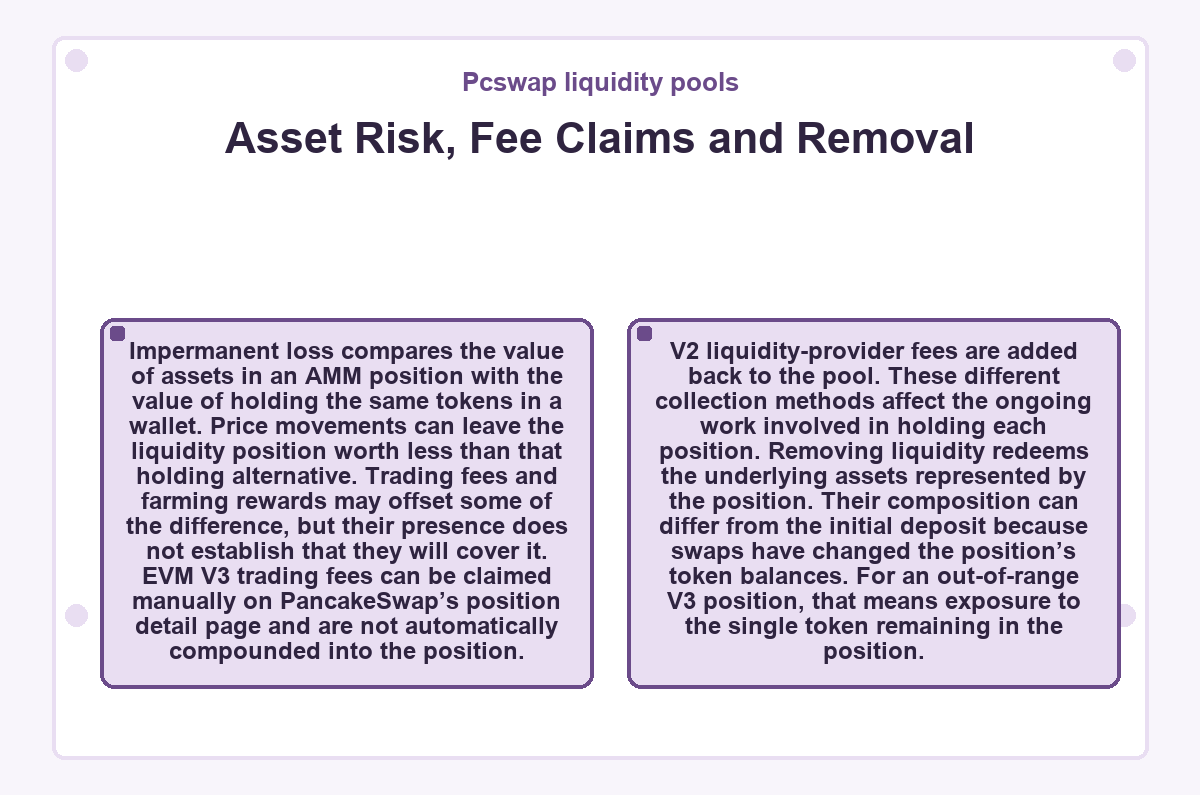
Removing liquidity redeems the underlying assets represented by the position. Their composition can differ from the initial deposit because swaps have changed the position’s token balances. For an out-of-range V3 position, that means exposure to the single token remaining in the position.
Liquidity Position Decision Checklist
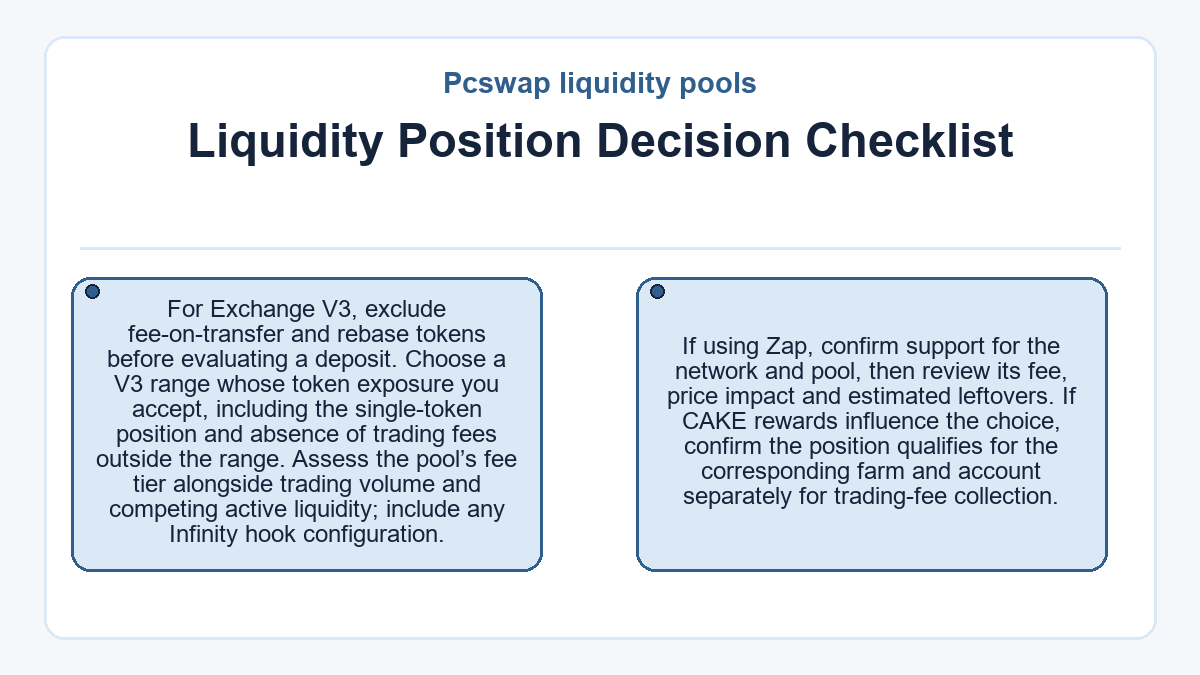
- For Exchange V3, exclude fee-on-transfer and rebase tokens before evaluating a deposit.
- Choose a V3 range whose token exposure you accept, including the single-token position and absence of trading fees outside the range.
- Assess the pool’s fee tier alongside trading volume and competing active liquidity; include any Infinity hook configuration.
- If using Zap, confirm support for the network and pool, then review its fee, price impact and estimated leftovers.
- If CAKE rewards influence the choice, confirm the position qualifies for the corresponding farm and account separately for trading-fee collection.