 Pcswap
: Trade Limits in PancakeSwap Pools vs Market Makers
last updatedOn BNB Smart Chain and Ethereum, PancakeSwap’s Exchange V3 routing can use AMM pools or separate market-maker quotes. Pool depth shapes execution for the requested trade size, while market-maker execution depends on an active quote covering the asset and amount. The available price and quantity can differ between these liquidity sources.
Liquidity Behind Each Quote
| Execution Factor | AMM Pool Route | Market Maker Quote |
|---|---|---|
| Liquidity Source | Assets liquidity providers deposit into pools. | The market maker’s own liquidity, held separately from AMM pools. |
| Trade Size | Available liquidity along the route affects the output for the requested amount. | The maker quotes amounts it is willing and able to execute; a large order can exceed its capacity. |
| Execution Structure | A trade can pass through multiple pools or be split across routes. | A trade executed by a market maker does not also pass through AMM pools. |
| Availability | A usable route must exist within the enabled liquidity sources and routing settings. | A maker must be quoting for the asset and requested quantity; quotes are not continuously available. |
Trade Size and Availability
Pool Depth and Active Ranges
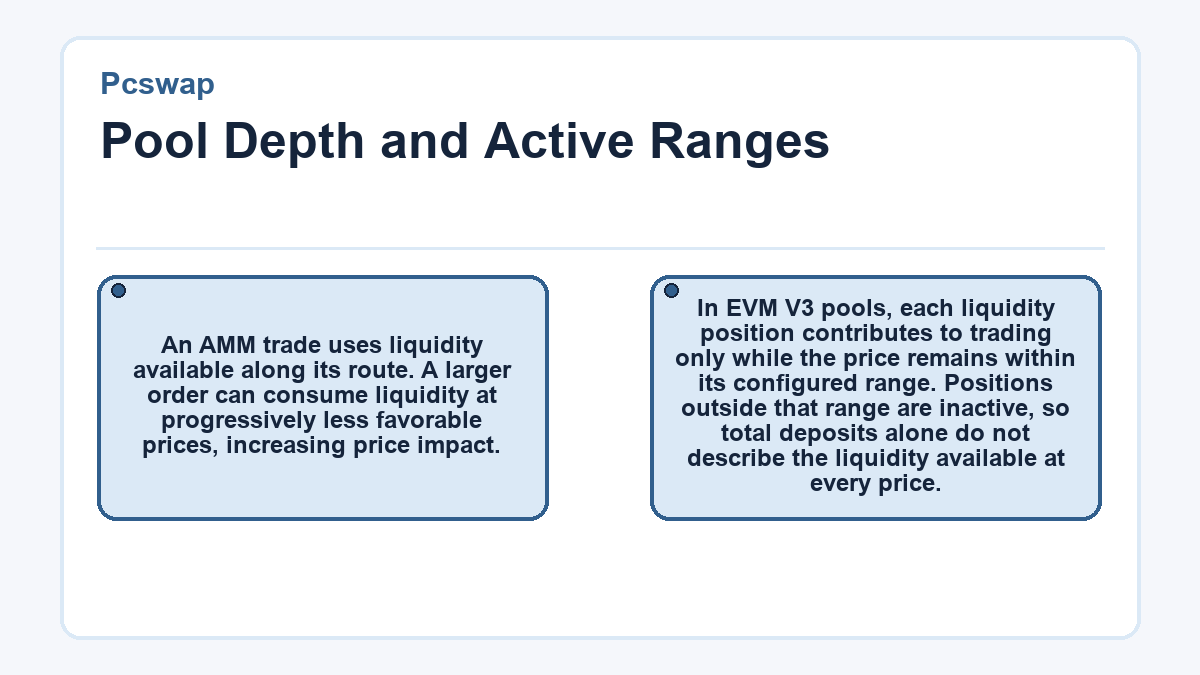
An AMM trade uses liquidity available along its route. A larger order can consume liquidity at progressively less favorable prices, increasing price impact. In EVM V3 pools, each liquidity position contributes to trading only while the price remains within its configured range. Positions outside that range are inactive, so total deposits alone do not describe the liquidity available at every price.
Market Maker Capacity and Downtime
A market maker determines the quantities it will execute from its separate liquidity. A quote available for a smaller amount does not establish that the maker can support a larger order in full. Makers can also stop quoting temporarily during system upgrades or major economic events.
Market-maker downtime can interrupt trading in a token whose only available liquidity comes from those makers. Where a usable AMM route also exists, that pool route remains a separate execution option, subject to its own liquidity and routing constraints.
Router Selection and Cost Trade-Offs
The Exchange V3 Smart Router compares available AMM execution with designated market-maker quotes. It selects a market maker when the maker offers a better price and uses AMM execution when the pools are more competitive. Market-maker execution can also serve a token without an existing AMM pool, provided a maker offers a usable quote.
AMM Route Configuration
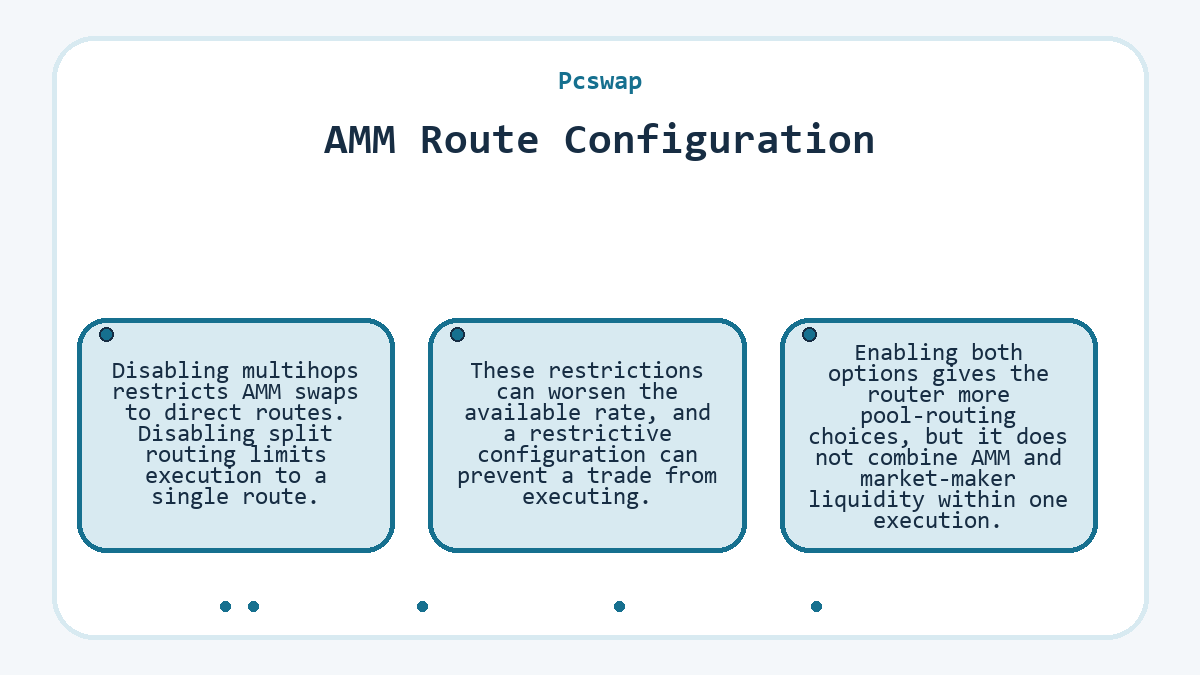
Disabling multihops restricts AMM swaps to direct routes. Disabling split routing limits execution to a single route. These restrictions can worsen the available rate, and a restrictive configuration can prevent a trade from executing. Enabling both options gives the router more pool-routing choices, but it does not combine AMM and market-maker liquidity within one execution.
Trading Fees and Quoted Output
AMM execution carries the fees applicable to the pools used along its route. For trades executed by its integrated market makers, PancakeSwap receives a commission from the maker and does not charge the trader a separate PancakeSwap trading fee. The quoted exchange rate and applicable network gas still matter when comparing total costs.
Execution Checklist
- For a large order, assess the quote for the full requested amount; a maker may have insufficient liquidity to execute it in full.
- If a market-maker quote is unavailable, check whether a usable AMM route exists for the selected token pair and network.
- If multihops or split routing are disabled, account for the direct-route or single-route restriction when assessing the quote.
- Compare quoted token output and displayed costs for the same input amount on the same network.